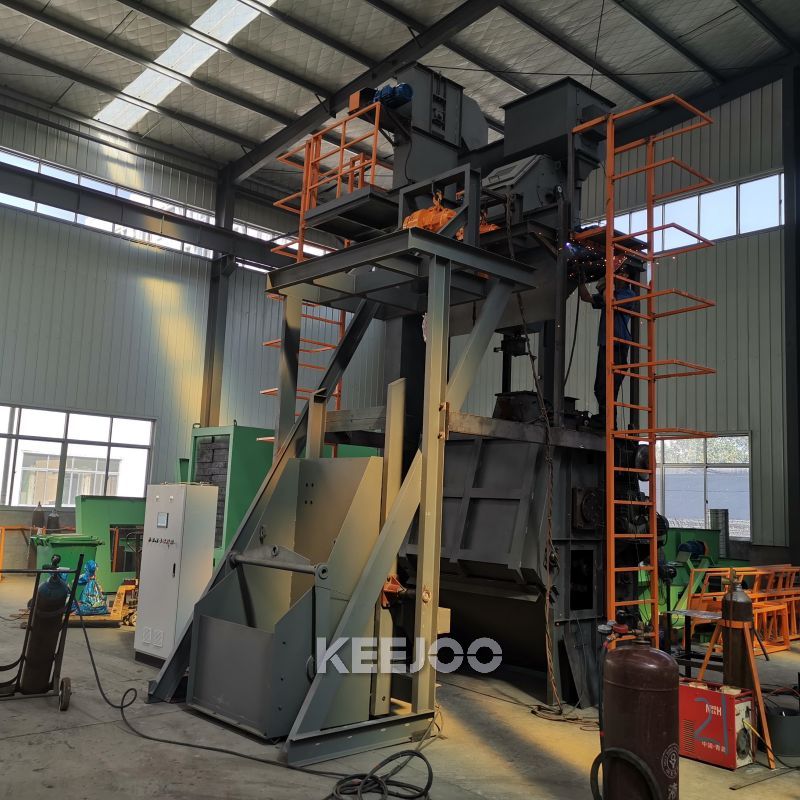
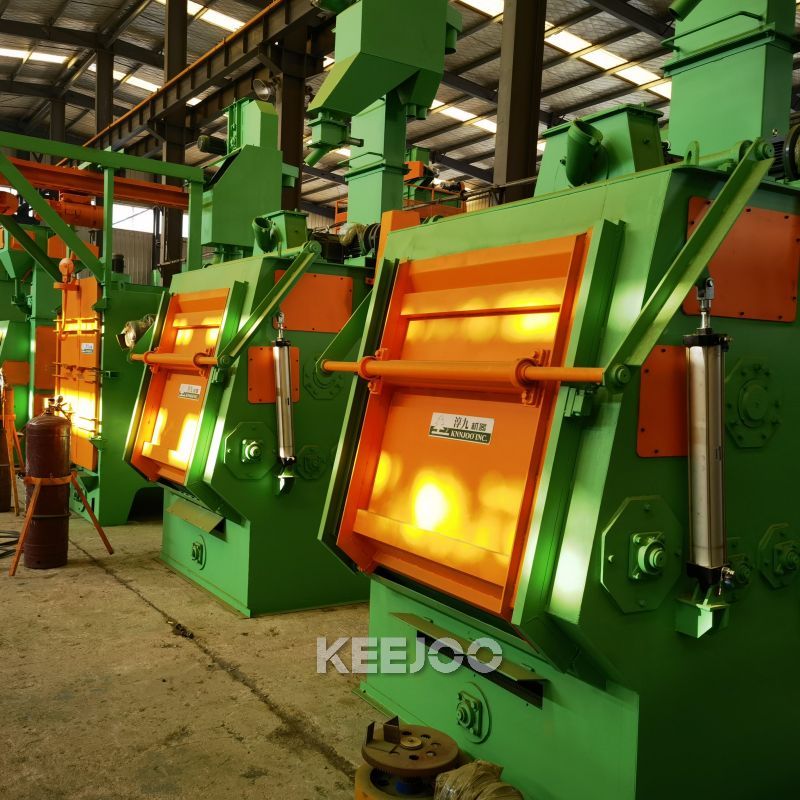
Rubber belt shot blasting machine
Production description
The crawler-type shot blasting machine is designed to cater to the needs of various industries, offering efficient sand cleaning, rust removal, oxide scale removal, and surface strengthening for small-sized castings, forgings, stampings, gears, springs, and other components. It is specifically built to handle workpieces that can withstand collisions, such as castings, forgings, and heat-treated parts.The machine features a robust crawler system that allows it to move smoothly across the workpieces, ensuring thorough and precise shot blasting. It utilizes high-speed rotating blast wheels to propel abrasive media onto the surfaces, effectively removing sand, rust, oxide scales, and other impurities. This process not only cleans the workpieces but also enhances their surface quality and strength.The crawler-type shot blasting machine offers adjustable parameters, allowing operators to control the speed, density, and angle of the shot blasting media. This flexibility enables customized surface treatment solutions for different materials and sizes of workpieces, ensuring optimal results.Equipped with advanced automation and control systems, the machine offers convenient and efficient operation. Operators can easily set and monitor parameters through a user-friendly touch screen or computer interface, improving productivity and ease of use.With its versatility and adaptability, the crawler-type shot blasting machine finds applications in various industries. It is particularly suitable for small castings, forgings, stampings, gears, springs, and other components that require sand cleaning, rust removal, oxide scale removal, and surface strengthening. Its reliable performance and precise shot blasting capabilities contribute to enhancing the overall quality and durability of the treated workpieces.
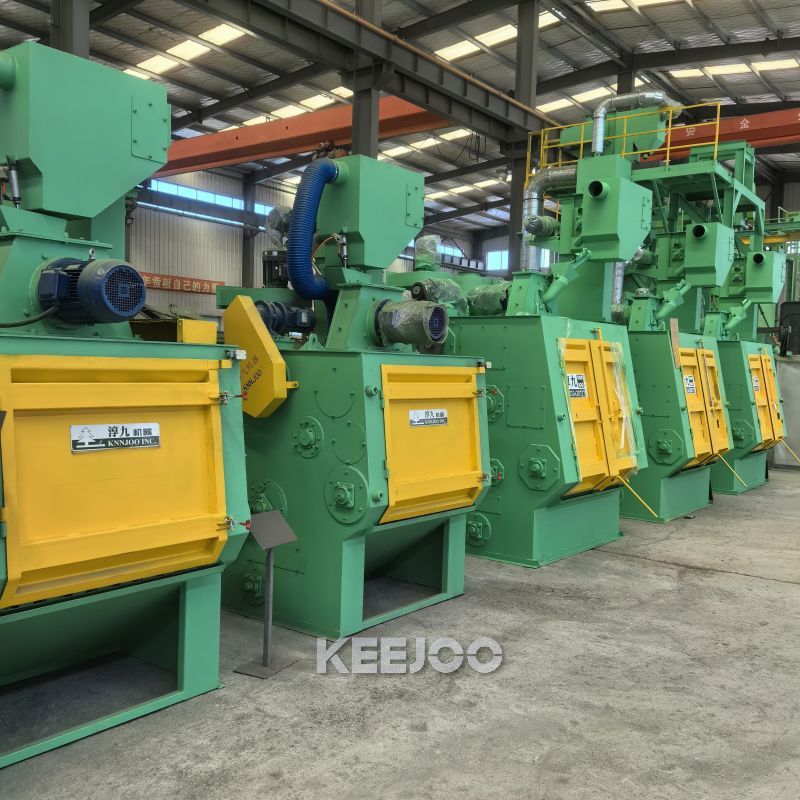
Technicial data
Parameter | Unit | 3GN | 8GN | 8GN-5R | 15GN |
Productivity | t/h | 0.6-1.2 | 2-4 | 2-3 | 3-5 |
Feeding Amount | kg | 220 | 650 | 650 | 1000 |
Max Weight of Single Work piece | kg | 12 | 32 | 32 | 55 |
Diameter of end disk | mm | 650 | 1000 | 1000 | 1150 |
Effective volume | m3 | 0.15 | 0.3 | 0.3 | 0.5 |
Abrasive flow rate | Kg/min | 180 | 270 | 270 | 300 |
Ventilation capacity | m3/h | 2300 | 3500 | 3500 | 5000 |
Total power | kw | 13.1 | 23.2 | 27.4 | 39.4 |
Working priciple
After loading the specified number of workpieces into the cleaning chamber, the machine is started, and the workpieces are driven by the rotating drum, causing them to tumble. Simultaneously, a curtain formed by high-speed projectiles ejected from the blast wheel strikes the workpiece surfaces uniformly, achieving the purpose of cleaning. The ejected projectiles and sand grains pass through small holes on the rubber track and flow into a steel plate mesh at the bottom for sieving. They are then transported by a screw conveyor into an elevator and lifted to a separator for separation. Dust is drawn into the dust collector by a fan, where it is filtered, and the cleaned air is discharged into the atmosphere. The dust on the filter cartridges is periodically cleaned by high-pressure backflushing, falling into the dust collection box at the bottom of the dust collector for regular removal by the user. Waste sand exits through a waste pipe, while the mixture of projectiles and sand is recycled by the elevator into the separator. Once separated in the separator, the clean projectiles enter the blast wheel through the supply gate and are propelled to strike the workpieces.
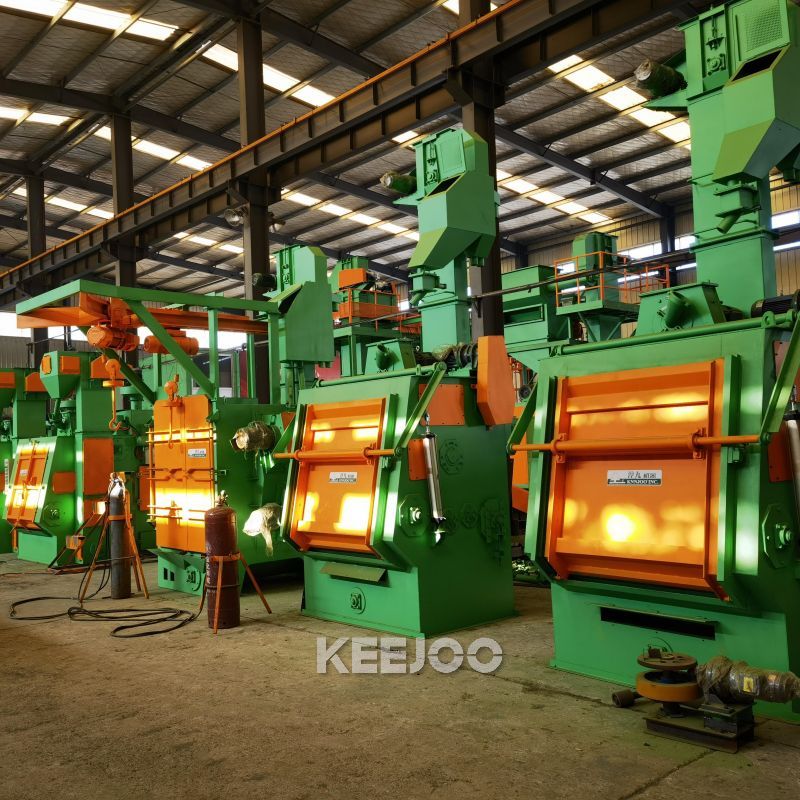
Feature
The machine utilizes a cantilever centrifugal blast wheel, characterized by a long service life and a simple structure.
It adopts the BE-type separator, which offers excellent separation efficiency and higher productivity, contributing to an extended lifespan of the blades.
The machine is equipped with a cartridge dust collector, ensuring that the dust emission concentration is lower than the national standards, thereby improving the working environment for the operators.
It features a wear-resistant rubber track, reducing the occurrence of collisions and damage to the workpieces while also minimizing machine noise.
After the completion of workpiece cleaning, it can automatically unload, reducing the labor intensity for the operators.